
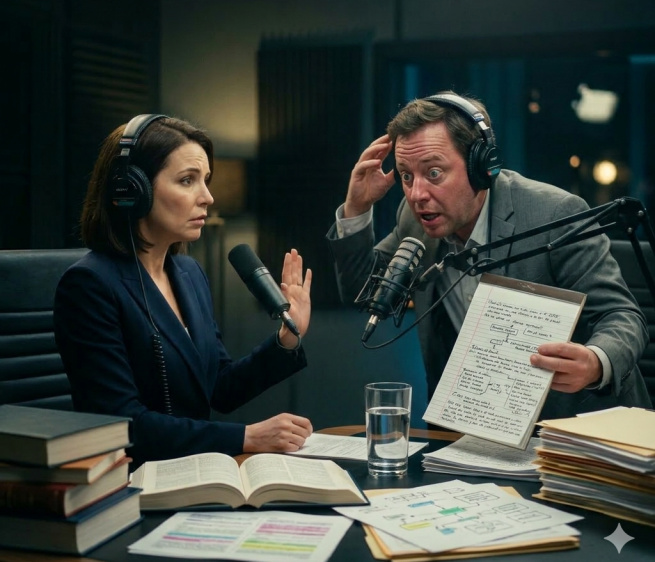
A while back, I watched an interview where the host got a key fact wrong about the guest’s work. Not maliciously. Not even carelessly. It was just one of those normal human moments where a detail gets flipped and something is said incorrectly.
You could actually see the guest’s brain light up, and then they had a choice.
Option one: jump in with a correction that’s technically right, but lands a little hard.
Option two: smile politely and let it go, even though the wrong fact quietly chipped away at their credibility for the rest of the segment.
Neither option is great, and this happens more often than you might think. A title gets misstated, a name is mispronounced, the timeline is off by a year, the host attributes your quote to someone else, or maybe they summarize your book in a way that is almost right, but not quite.
This is where Media Darlings separate themselves from smart people who accidentally sound prickly. You see, the good news is that there is a way to correct the record without sounding defensive. This is where skill mixed with finesse comes into play.
Media Darling Moment: Correct the fact, then come right back to the point.
Here’s the method I teach for this exact moment.
I call it Quick Correction, Quick Return. It keeps you warm, credible, and it keeps the interview moving forward without this “thing hanging out there.” And it protects the relationship with the host, which matters more than winning a fact check.
Here is the method so you can use it next time this happens to you:
1) Quick correction
You correct the detail in one clean line. This is not the time for a lecture or a rebuttal. You’re just going to do a calm, friendly reset.
Examples:
- “Tiny correction, it was 2019, not 2020.”
- “Small detail, it was my second book, not my first.”
- “Just to clarify, the study was on adults, not teens.”
- “Quick note, it’s pronounced ___.”
- “Actually,….” and then say what the truth is.
2) Quick return
Then you immediately return to the point you want the audience to remember.
This is the part most people miss. They correct the fact, and then they keep correcting. They start building a case. They add context. They prove they are right, and this is where all that defensiveness creeps in. Forget all that. It’s a bad idea and it never makes you look good and like the professional you are.
Instead, you pivot back to your message:
- “And the reason that matters is…”
- “What’s important here is…”
- “The bigger point is…”
- “Here’s what that means for your listeners…”
That is your return. Simple. You are essentially saying: we’ve corrected the small thing, now let’s keep serving the audience.
Then there is the tone rule that keeps you out of trouble. You see, if your tone says “I’m embarrassed you got that wrong,” you lose.
Or if your tone sounds a little angry or irritated that they got it wrong, you lose.
If your tone says “No worries, here’s the correct detail,” you win.
Warmth is the secret weapon, and you know how to be warm. The audience is not grading your precision, they are actually reading your energy. If you don’t make a big deal out of it, neither will they.
And just to make sure this is totally clear, let me share with you what not to do. Here are the two most common mistakes:
Over correcting
You turn one fact into a five minute clarification. The interview becomes about the correction instead of your message.
Under correcting
You say nothing, and now the wrong detail is attached to you permanently in the listener’s mind.
The method solves both. Correct it briefly, then move forward.
Here’s a mini example you can use:
Host: “Your book came out last year, and it’s already been translated into ten languages.”
You: “Quick correction, it came out in 2023, and it’s currently in six languages. And what’s exciting about that is the message is traveling because the problem is everywhere…”
Notice what happened.
No awkwardness. No ego. No steamrolling.
Just credibility, warmth, and momentum.
Bottom Line
You do not need to choose between being right and being likeable. You can be both. So remember to correct the fact, return to the point, and keep your tone warm.
That is how you protect your credibility and keep the interview moving.
To your success!
Joanne
P.S. If you want to handle moments like this without freezing, flinching, or sounding defensive, join my Media Training Course for Authors and Experts with the Nonfiction Authors Association. It begins Tuesday, April 7 at 1:00 p.m. Eastern Time, 10:00 a.m. Pacific Time, and yes, it will be recorded. Join me here.
P.P.S. Want a sneak peek first? Join me for the free webinar, Stop Winging It During Media Interviews. Join me here.
P.P.P.S. Tell me the truth, but do it with warmth.
#MediaTraining
#NFAA
#BookMarketing
#BookPublicity
If you’d like to receive juicy publicity secrets directly on a regular basis, join the Savvy Sunday Community at the bottom of this page.