
I was listening to a podcast recently and, of all things, the guest was a media trainer. You would think this would go beautifully, but life is filled with surprises.
The host asked a question, the guest answered it, and then everything came to a complete stop.
Another question from the host. Another answer from the guest and then everything came to a complete stop.
Another. Same thing.
At first, the host kept trying. You could almost hear her scrambling to come up with fresh ways to keep the conversation alive, but after a while, she gave up trying to hold up both sides of the conversation. Instead of building elegant transitions and asking the next question, she just started saying, “And then what happened?” “And then what happened.” Over and over again.
The power dynamic shifted completely.
And that told me everything.
The guest was technically answering the questions, but he was not helping move the interview forward. He was treating each answer like a finished little island, instead of part of a larger conversation. So the host had to do all the heavy lifting, and eventually she just didn’t want to play that game anymore.
This is such an important lesson for anyone who wants to become a better guest.
Because your job is not only to answer the question. Your job is to answer it in a way that makes the next question easier to ask.
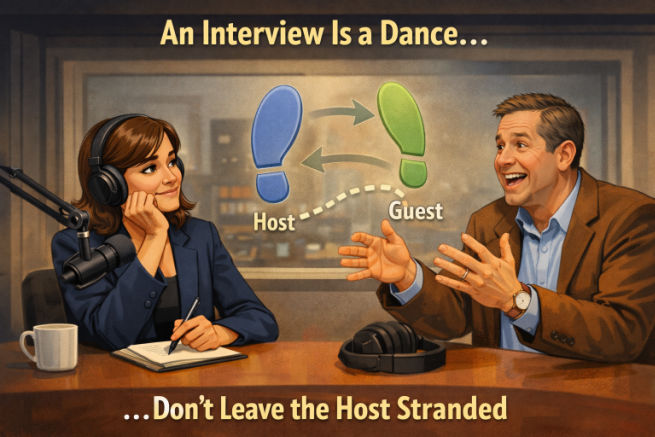
Media Darling Moment: An interview is like a dance. There are two people in it, and great guests know how to move with the host, not leave her standing there.
This is one of those subtle skills that makes someone sound polished without sounding rehearsed. Most listeners would never name it, but they can feel it immediately. One interview feels choppy, while the other feels smooth, natural, easy, and alive. Often, the difference is right there in how the guest ends each answer and tees up the next question.
You see, an interview really is a partnership. Yes, often the host is guiding the conversation, but the guest has much more power than he or she realizes, and an obligation to help create the rhythm too. You are not there to deliver isolated little speeches and then wait for the next question. You are there to help create flow, and the way you do that is to elegantly steer the conversation in a new direction making it easy for the host to take your lead.
That is why you do not want to end with a full stop every time. You want to end with a soft handoff.
That does not mean you ramble. It does not mean you tack on three extra thoughts because you are afraid of silence. It means you close your answer in a way that naturally opens the door to what comes next.
For example, let’s say the host asks how you got interested in your topic. You answer that. Fine. But if you stop dead at the end, the host has to search for the next opening. If instead you end with something like, “And that was really the moment I realized this was much bigger than I thought,” you have just handed the host a beautiful next step. Now she can ask what made it bigger, what changed, what happened next, or why that is important.
And that is the dance. That is the handoff.
A good handoff does one of three things. It hints at a story. It introduces a tension. Or it opens a loop the host will naturally want to close.
Here are a few examples:
- “That was the first sign that something deeper was going on.”
- “And what surprised me most came after that.”
- “And that is where the real problem began.”
Do you hear the difference? These endings do not feel pushy. They do not sound like you are controlling the interview. They simply give the host something to grab onto.
That is a gift. And hosts love guests who make their jobs easier.
What happened in the interview I was listening to is that the guest kept ending answers so abruptly that the host had no material to work with. So she defaulted to the simplest possible line, which was “And then what happened?” Again and again.
Now, to be fair, that question can work. Sometimes it is exactly the right question. But when it becomes the only question, it is often because the guest is not helping build the conversation.
And of course, there is a mistake to avoid here too. Some people hear this advice and think it means they should stuff every answer with teasers and transitions until they sound like a movie trailer, but that is not what I’m saying here. The goal is not to sound dramatic. The goal is to sound helpful, and have a dance with the host.
So as you think about your interviews, remember not to just finish your answer. You want to hand the host the next step by teeing up the next question.
That is how you create flow, keep the rhythm alive, and is how a Media Darling helps the whole interview shine.
To your success!
Joanne
P.S. Last chance. If you want to learn how to answer questions in a way that sounds natural, confident, and actually helps the interview move forward, join my Media Training Course for Authors and Experts with the Nonfiction Authors Association. It begins this Tuesday, April 7 at 1:00 p.m. Eastern Time, 10:00 a.m. Pacific Time, and yes, it will be recorded. Join me here.
P.P.S. I Hope You Dance!
#MediaTraining #NFAA #MediaDarling #BookMarketing #BookPublicity
If you’d like to receive juicy publicity secrets directly on a regular basis, join the Savvy Sunday Community at the bottom of this page.