
A few years ago, I was standing in a hotel lobby waiting for an elevator with a group that had just left a conference. Someone asked a woman, “So what do you do?” And you could see her brain open twelve tabs at once. She started explaining, clarifying, adding context, and by the time the doors opened, everyone was nodding politely, but no one knew what to say back. Then the guy next to her answered the same question with one clean line, smiled, and stepped into the elevator like it was nothing. Everyone remembered his statement. Not because he was smarter, but because he was clear.
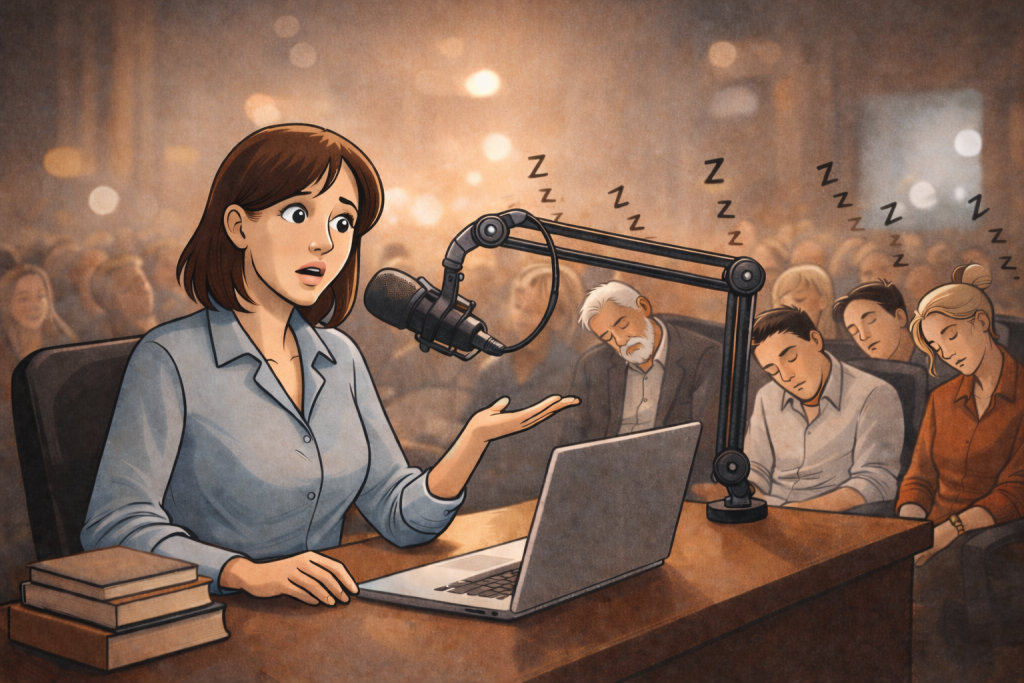
When doing media interviews, somewhere between “I have so much to say” and “Oh no, they’re about to toss it to me,” a very smart author and expert can fall into a very long answer.
This is not because they are unprepared or unclear. And it is not because they are “bad on the air.” It’s because the message has not been pressure tested yet.
And earned media can be a pressure cooker. No doubt about it.
But here is the 10 second rule I want you to borrow this week:
If you cannot say what your core idea is in 10 seconds, you do not yet own the message. Period.
I’m not talking about the whole interview. This is not your whole life story. We are talking about the one point you really want the audience to remember, repeat, and share. The point you want to be “sticky.”
Media Darling Moment: A message is sticky when it lands fast and stays. It is clear, vivid, and repeatable, so a producer can grab it, a host can quote it, and your audience can remember it later without effort.
You see, most authors and subject matter experts start with a value proposition that is technically correct, but is not yet refined.
It sounds like this:
“I help organizations understand the complex interplay between X and Y so they can improve Z through an integrated approach.”
Huh?
Is it true? Yes. Is it memorable? No. Is it bookable? Also no.
You do not need more information. You need sharper language.
Media does not reward thorough. It rewards clear. We’ve talked about this before in previous posts, but it is always worth repeating.
You know when you have nailed something, and when your message is too long. You can feel it in your body. You know when it isn’t there yet, so listen to that.
You walk into the interview with a quiet anxiety running in the background. Questions float around such as… “What if I ramble?” “What if I lose my point?” “What if I sound scattered?”
So you over explain. You add context, you qualify your statements, you try to be responsible, accurate, and nuanced, and it ends up being just way too much.
And then the moment passes.
Ten seconds later, the host has moved on, and your best thought is still warming up in the wings.
Here’s what is going on. Long answers create three problems that show up fast:
- Producers cannot “see” the segment.
- Hosts cannot pull the headline from you.
- Audiences cannot remember what you said.
None of this is good for you. It translates into lower booking rates and forgettable appearances. And remember, this is not because you lacked expertise, but because your expertise did not land.
This is where soundbites rescue you. Take one big idea and shape it into 3 to 5 tight lines that work in your category. Lines you can say naturally. Lines that sound like you. Lines that create a clean, memorable “Ohhhh, I get it.”
Concepts are fine. But when it gets right down to it, you need clarity, and this is by far and away one of the main problems I see with authors and experts looking for earned media coverage.
So let me ask you this, and answer in one sentence:
What do you want the audience to do after hearing you?
Now say it again, but make it sound like something a real person would say to a friend.
So here are a few examples of what this can sound like.
- “Most people are doing the right thing, in the wrong order.”
- “If you cannot explain it simply, you cannot sell it.”
- “Clarity is not a personality trait. It’s a skill.”
- “Your audience does not need more information. They need a decision.”
Notice what these do. They create a clean mental click. A headline. A hook. Something that grabs another person, whether it is a host, producer, editor, journalist. They get it and they get you.
I once watched a producer prep a guest right before a segment. The guest was sharp and credible, but when the producer asked, “What’s your main point?” the answer turned into a paragraph. The producer held up a hand and said, kindly, “Stop. Give me the headline.” The guest tried again, still long, and the producer smiled and said, “You are giving me the article. I need the banner.” That is the 10 second rule right there. The banner is what gets remembered.
To your success!
Joanne
P.S. You do not need more words. You need your words.
#10Seconds
#SavvySunday
#MediaDarling
#BookMarketing
#BookPublicity
If you’d like to receive juicy publicity secrets directly on a regular basis, join the Savvy Sunday Community at the bottom of this page.