
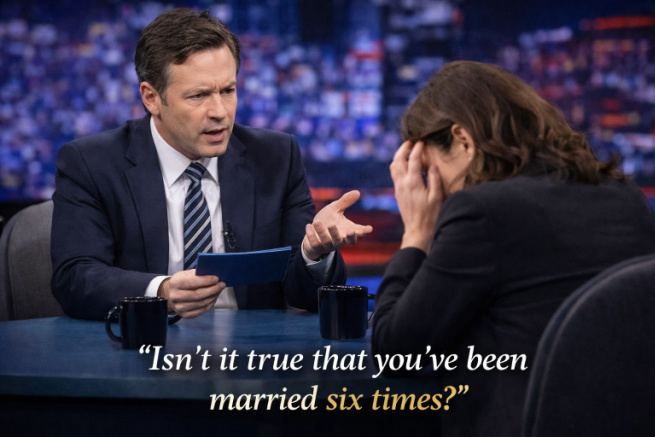
Years ago, I was interviewing a celebrity relationship expert who had been married six times.
You can probably guess the question sitting in the room before anyone even said it out loud.
Why should anyone take relationship advice from someone who has been married six times?
That is the kind of question people dread in interviews. The one they hope the host will politely skip. The question that makes their stomach tighten long before they ever sit down for the interview. The one they try not to think about because surely if they do not think about it, maybe the host will not go there.
But of course, that is not usually how it works.
What we avoid tends to grow teeth. You may know exactly what I mean.
I have seen this again and again with clients. One man I worked with, a young company founder at 22, had committed a felony related to international shipping laws. It was not something he did intentionally, but decades later, at 54, he was still afraid it might come up in interviews. And he was right to be concerned. In this day and age, you can’t hide much, if anything.
Think about that.
More than thirty years had passed, and the anxiety was still there. Not because he was still that young man, but because he had never found a way to face the question and feel good about his response.
And that is what so many people do. They hope the scary or irritating question will not come up, and then they spend days worrying, running imaginary disasters in their mind, and feeling anxious before the interview even begins. If you do this, there is no way you will be at your best when the time comes.
But there is a much better way, and this is it.
My advice? Do not avoid the question. You must meet it.
Imagine the questions that bother you. The ones that make you defensive. The ones that feel intrusive, rude, skeptical, or just plain annoying. Write them all down. Look at them on paper, and then find a way to answer that feels true, steady, and takes the pressure off.
That relationship expert did not need to panic about being married six times. She needed a response that made sense of it.
And she was brilliant. Instead of shrinking from it, she answered with humor and ease.
She said, “Most people have a boyfriend in high school. Then they go to college and have a boyfriend, maybe two. Then they meet someone, live together for a while, and break up. Eventually they marry. Maybe that does not work out and later they marry again. I just married each one along the way.'”
And the client with the old felony did not need to live in fear of the question forever. He needed language that acknowledged the past clearly, took responsibility where appropriate, and reflected the truth of the man he had become.
Something like: “That happened when I was very young, and it was a serious experience that taught me a great deal. It involved international shipping laws, and while there was no harmful intent, I learned firsthand how important responsibility, detail, and accountability are in business. I have carried those lessons with me ever since.”
Now we have something to work with.
Not a dodge or a collapse. Not a defensive little speech. A response.
That is what preparation does. It takes the emotional charge out of the question. It gives you somewhere solid to stand.
The truth is, some interview questions will scare you. Some will irritate you. Some will sound simplistic, nosy, or even a little insulting. But when you have already faced them in advance, they stop owning the room, and that changes everything.
Instead of thinking, Please do not ask me that, you start thinking, I know exactly what I want to say if you do.
That is a completely different energy.
You feel less hunted. More ready. Less anxious. More grounded. Less like you are bracing for impact and more like you know how to handle yourself.
And here is one of the strangest things. When you have found an answer so strong, so true, and so comfortable that you almost look forward to being asked the hard question, that is often when it never comes up. Something shifts. The fear is gone, your energy is different, and somehow the question loses its grip before it is ever asked.
This is one of the most important parts of media training. We do not just practice the fun questions. We practice the ones that make you squirm.
Because the goal is not to become slick. The goal is to become comfortable telling the truth in a way that serves you.
Media Darling Moment: The question you fear most is often the one that most needs your calmest answer.
In the end, this is not just about handling a difficult question. It is about reclaiming your ease. When you know you can respond well to the thing you feared most, you stop walking into interviews braced for impact. You walk in ready. And very often, that readiness changes the whole conversation before the question is ever asked.
To your success!
Joanne
P.S. The song in my head for this one is Tom Petty’s I Won’t Back Down. Quiet strength. Steady ground. And exactly what a tough question calls for.
#MediaTraining
#MediaDarling
#InterviewTips
#BookPublicity
#SavvySunday
If you’d like to receive juicy publicity secrets directly on a regular basis, join the Savvy Sunday Community at the bottom of this page.