
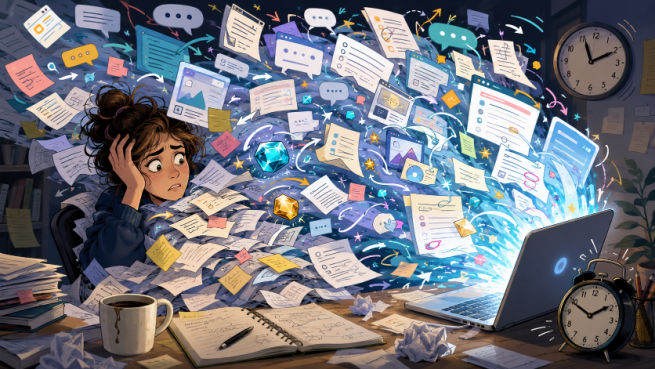
AI is supposed to save us time according to all the talk online. And sometimes it does.
It can help brainstorm ideas, organize information, suggest titles, tighten a paragraph, or point us toward an angle we had not considered.
But there is another side to it that receives far less attention.
AI can also happily waste hours of your precious time.
I experienced this recently while brainstorming ideas. The first round produced some promising possibilities. One idea needed to be adjusted, though, so I refined the prompt. The next response solved part of the problem but created another one. Then the tone needed work. Then an important point disappeared. Then I wanted to recover one strong phrase from an earlier version.
Before long, I had a mountain of material. ugh.
There were some genuine gems in that mountain, but most of them were not useful. Something I could probably have completed in 15 minutes had expanded into a two-hour project or maybe more.
The problem is not simply the time involved.
AI is not an oracle. It is a machine that depends on prompts, patterns, and the information available to it. Even with a strong prompt, it can sound certain while being incomplete or wrong.
It can give you an answer that sounds polished, confident, and complete while missing something essential. Unless you already understand the subject, you may not recognize what has been left out or what is simply wrong. And, boy, can it get it wrong.
I see this clearly when AI offers advice about pitching the media.
It may produce a perfectly respectable-looking email on the surface, but pitching requires much more than writing a pleasant note. You must identify the right outlet and the right person, understand what they cover, find an angle that matters to their audience, and approach them as a human being. There is strategy behind every effective pitch, and if you simply depend on AI to know what belongs in one, it is likely to miss something important.
This is part of what journalists are referring to when they complain about “AI slop,” and they are receiving a great deal of it. The problem is not merely bad writing. It is generic outreach that lacks a genuine understanding of the person receiving it. This is absolutely critical.
That does not mean AI has no place in the process. It can be helpful for brainstorming, developing talk titles, challenging your ideas, or helping you see an angle you may have missed. But it works best when you know enough to direct it, question it, and recognize when it does not know what it is talking about. Haha…and that is fairly often.
While I was mulling this over and writing today’s Savvy Sunday News, my friend, Peter Shankman, wrote about much the same thing this week. His piece is called “AI Will Happily Eat Your Whole Afternoon.” He writes about it here.
His timing made me laugh, and it also confirmed that I am not alone in this.
AI can be a terrific assistant. But it still needs a knowledgeable human being at the wheel. Don’t overly depend on it.
Media Darling Moment: AI can help you move faster, but only expertise can tell you whether you are moving in the right direction.
To your success!
Joanne
P.S. On August 11, I am presenting a webinar on The 5 Publicity Mistakes That Keep Authors and Their Books Hidden. You can learn more and register here. It’s free, so come join me.
P.P.S. And the song for today: Does Anybody Really Know What Time It Is? by Chicago. Because AI can save time, but sometimes you look up and wonder where the whole afternoon went.
#ArtificialIntelligence
#BookMarketing
#BookPublicity
If you’d like to receive juicy publicity secrets directly on a regular basis, join the Savvy Sunday Community at the bottom of this page.