
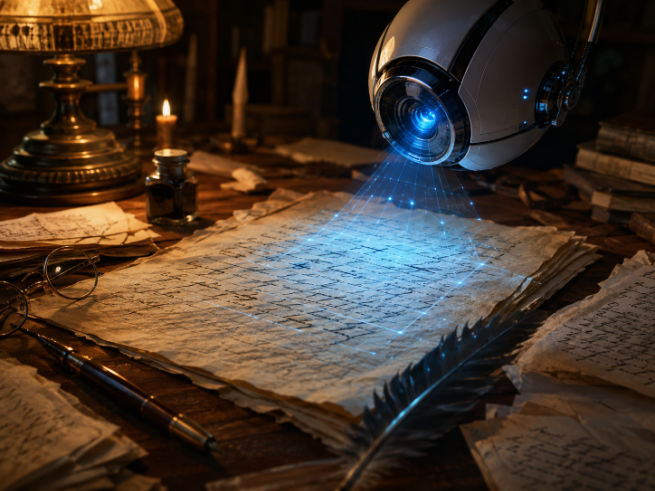
Apparently, the Founding Fathers used AI.
Who knew?
I came across something recently that sent me down a bit of a rabbit hole.
The U.S. Constitution, written in 1787, has been put through AI detectors, and some of them have concluded that portions of it were written by artificial intelligence.
One reported test even came back with a score of more than 90 percent AI-generated.
Obviously, James Madison was not sitting there prompting ChatGPT. Haha.
It is funny, but it also illustrates a growing problem. AI detectors are increasingly being used to determine whether something was written by a human or generated by a machine. And sometimes they get it spectacularly wrong.
Perhaps we should not be surprised when you think about it. After all, generative AI was trained on enormous amounts of human writing, including books, articles, journalism, academic papers, business writing, and websites.
In other words, AI learned from us! Remember this.
I have been writing professionally for most of my adult life. For years, I have written pitches to producers, editors and journalists, along with press releases, articles, newsletters, books, presentations, talking points, and more pitches than I could possibly count. I’ve also had a blog for over 25 years.
All this to say, long before ChatGPT existed, I had developed a writing style.
I know how I like a sentence to sound. I know when something feels too short and choppy and when I want a longer sentence because it carries a thought more naturally. I know when something simply does not sound like me.
But this is certainly not just about me.
Think about all the experienced authors, journalists, editors, publicists, marketers, copywriters, and other professional communicators who spent years, sometimes decades, developing their craft before generative AI arrived.
Now their writing can be fed into a machine that assigns a percentage suggesting another machine wrote it.
Hello!
That is because an AI detector does not actually know who wrote something. It looks for patterns and makes an assessment. That is very different from establishing authorship.
Even the companies that make some of these tools acknowledge that false positives happen and caution against treating a score as absolute proof. That does not mean AI detectors have no value. They can be useful as one clue, especially when something feels off or warrants a closer look. But they should start a conversation or review, not end one.
And this has real implications.
An author may worry that a manuscript will be labeled AI-generated. An editor may question perfectly legitimate writing. A publicist or marketer may find original copy flagged by a detector. Media professionals may now wonder whether some of the pitches they receive were actually written by the person sending them. Publishers and businesses are trying to decide how much weight to give these tools. Students, of course, are already dealing with the consequences.
And some writers are changing perfectly good sentences because they have been told they “sound like AI.”
That one really gets my attention because I have caught myself doing it too. “This sentence is too good. Maybe I should change it so no one questions if I wrote it.” That is a little crazy when you think about it.
For decades, good writers have been taught to communicate clearly, get to the point, organize their thoughts, and vary sentence length. You should eliminate unnecessary words and make it easy for the reader to follow you, too.
All this to say, learn your craft.
Should an experienced writer now deliberately make the writing worse so a machine will believe a human wrote it?
Of course not.
There certainly is AI-generated writing that sounds like AI. We are becoming familiar with some of its tendencies. Certain words and rhythms show up repeatedly, and completely AI-generated content can sometimes have a polished sameness and a certain blahness to it.
But suspicion is not proof, and a detector score is not proof either.
I use AI. Most people reading this probably do too. It can help us brainstorm, research, organize material, challenge an idea, or see something we might have missed. This is valuable. It should make our work better.
But there is an enormous difference between using AI as a tool and turning your thinking, experience and voice over to it.
So perhaps instead of asking only, “Did AI touch this?” we need better questions.
Is there original thinking here? Is there experience behind these words? Is there a point of view? Does this person have expertise? Do they actually know what they are talking about? Does this sound like someone with something meaningful to say?
Those questions tell me far more than whether a detector spits out 17 percent, 42 percent, or 92 percent.
Especially when a detector can look at a document written in 1787 and decide artificial intelligence probably had something to do with it.
Haha…come on.
I have been writing like this for decades.
And many of you have too.
AI came later.
Media Darling Moment: Do not let a machine bully you out of your own writing voice.
To your success!
Joanne
P.S. What better song for a week spent wondering whether machines can really tell us who wrote that? Supertramp says it best.
#AIDetectors
#SavvySunday
#BookMarketing
#BookPublicity
If you’d like to receive juicy publicity secrets directly on a regular basis, join the Savvy Sunday Community at the bottom of this page.